
Think back to where your business was six months ago.
Since January, you’ve likely added employees, adopted new technology, onboarded vendors, expanded services, or adjusted how your team works. Growth is a good thing—but every change introduces new risks that aren’t always obvious in the moment.
The challenge is that these risks rarely appear overnight. They develop gradually as systems, processes, and responsibilities evolve.
Mid-year is the perfect time to step back and ask an important question:
Has your technology environment kept pace with the changes in your business?
Here are six areas worth reviewing.
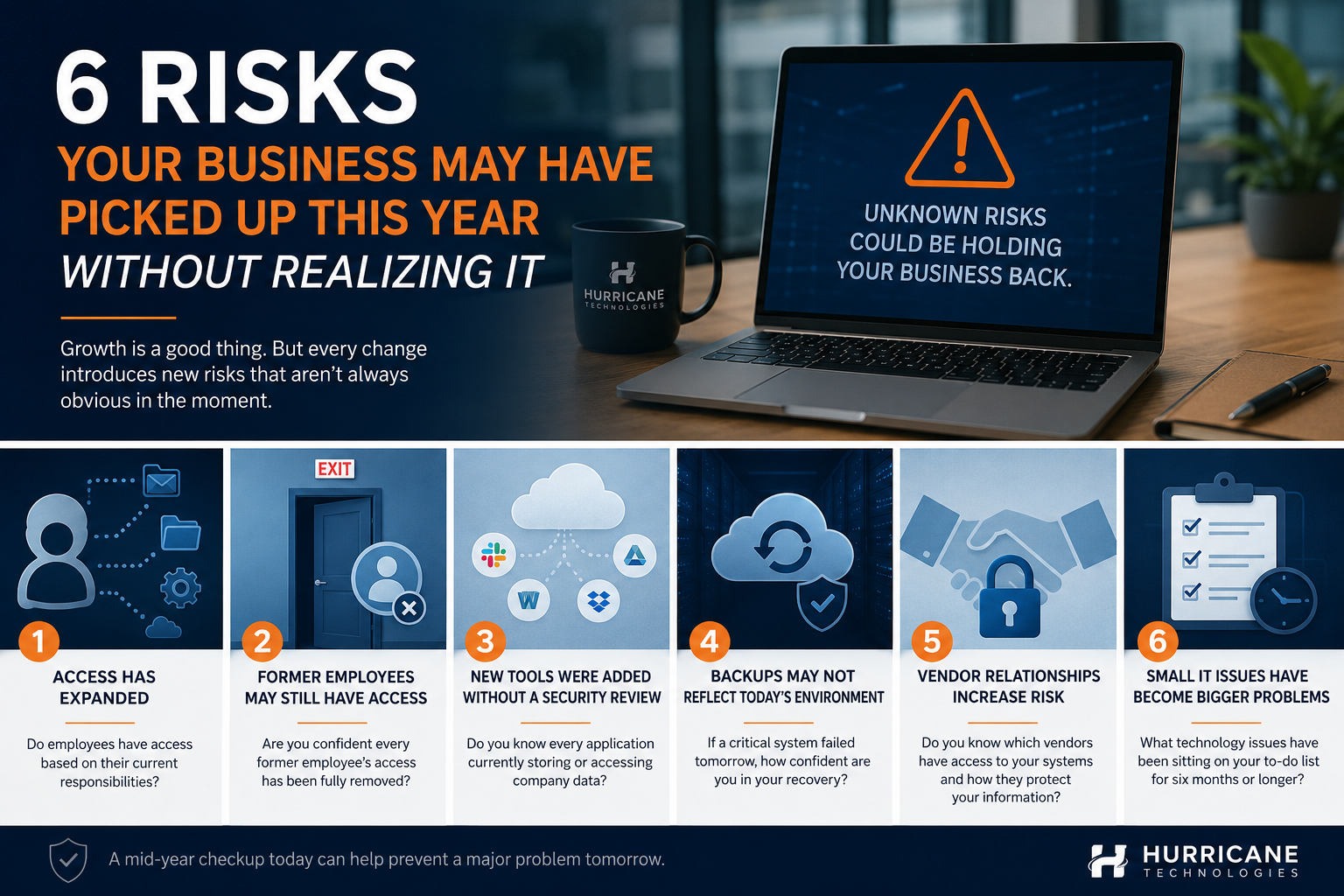
1. Employee Access Has Expanded Over Time
Every new hire needs access to email, files, applications, collaboration tools, and business systems.
In fast-growing organizations, access is often granted quickly so employees can get to work. Over time, however, permissions can accumulate. Employees may end up with access to information, systems, or resources they no longer need.
This isn’t usually intentional—it’s simply what happens when business moves faster than documentation.
Ask yourself: Do employees have access based on their current responsibilities, or has access gradually expanded over time?
2. Former Employees May Still Have Access
Employee departures are often focused on transitions, knowledge transfer, and maintaining continuity for customers and coworkers.
Unfortunately, technology offboarding doesn’t always receive the same level of attention.
Inactive accounts, forgotten applications, shared credentials, and overlooked vendor portals can remain accessible long after someone leaves the organization.
Even one missed account can create unnecessary risk.
Ask yourself: Are you confident every former employee’s access has been fully removed?
3. New Technology Has Been Added Without a Security Review
Today’s business teams are resourceful.
When employees find a tool that improves productivity, collaboration, or customer service, adoption can happen quickly. In many cases, these tools begin storing company information or connecting directly to business systems before anyone evaluates the security implications.
This isn’t necessarily a problem—but it does create blind spots.
Understanding where your data resides, who can access it, and how it is protected becomes increasingly important as your technology stack grows.
Ask yourself: Do you know every application currently storing or accessing company data?
4. Your Backup Strategy May Not Reflect Today’s Environment
Most businesses understand the importance of backups.
What often gets overlooked is whether those backups still align with the way the business operates today.
New applications, cloud services, file locations, and workflows can emerge throughout the year. As technology evolves, backup and recovery strategies need to evolve as well.
Just as importantly, backups should be tested regularly to confirm they can be restored when needed.
Because having a backup and being able to recover from it are two very different things.
Ask yourself: If a critical system failed tomorrow, how confident are you that recovery would be quick and successful?
5. Vendor Relationships Have Increased Your Risk Surface
Every vendor relationship creates a connection to your business.
Whether it’s a software provider, accounting platform, marketing agency, payroll company, or managed service provider, third parties often have access to systems, data, or business processes that support your operations.
Most organizations evaluate vendors based on capabilities and cost. Fewer take the time to evaluate cybersecurity practices, access controls, and data protection measures.
As businesses grow, these third-party relationships deserve periodic review.
Ask yourself: Do you know which vendors have access to your systems and how they protect your information?
6. Small IT Issues Have Become Bigger Problems
Every organization has a list of technology tasks that get pushed to “later.”
Unused accounts. Old hardware. Security settings that haven’t been reviewed. File shares that have become disorganized. Documentation that never got updated.
None of these issues seem urgent individually.
But over time, they create complexity, increase risk, and make technology harder to manage.
The longer they’re ignored, the more difficult they become to address.
Ask yourself: What technology issues have been sitting on your to-do list for six months or longer?
A Mid-Year Technology Checkup Can Go a Long Way
The good news is that most of these risks are both common and manageable.
The first step is simply knowing where they exist.
Taking time to review access controls, vendors, security practices, backup strategies, and lingering technology issues can help uncover vulnerabilities before they become costly disruptions.
As your business grows, your technology environment should grow with it.
If you’re unsure where potential gaps may exist, Hurricane Technologies can help. Our team works with organizations across Western New York to evaluate technology risks, strengthen cybersecurity, and ensure IT supports long-term business goals.
A fresh perspective can often identify issues that are easy to overlook when you’re focused on running the business every day.
Let's Talk
Take the first step to review your business with a mid-year checkup.