

You don’t need to be an IT expert to run a successful business.
You do, however, need visibility into the systems, data, and processes that keep your business running every day.
Technology has become intertwined with nearly every aspect of operations—from customer communications and financial management to employee productivity and cybersecurity. When something goes wrong, business leaders are often expected to make decisions quickly.
The question is: do you have the information you need to make those decisions confidently?
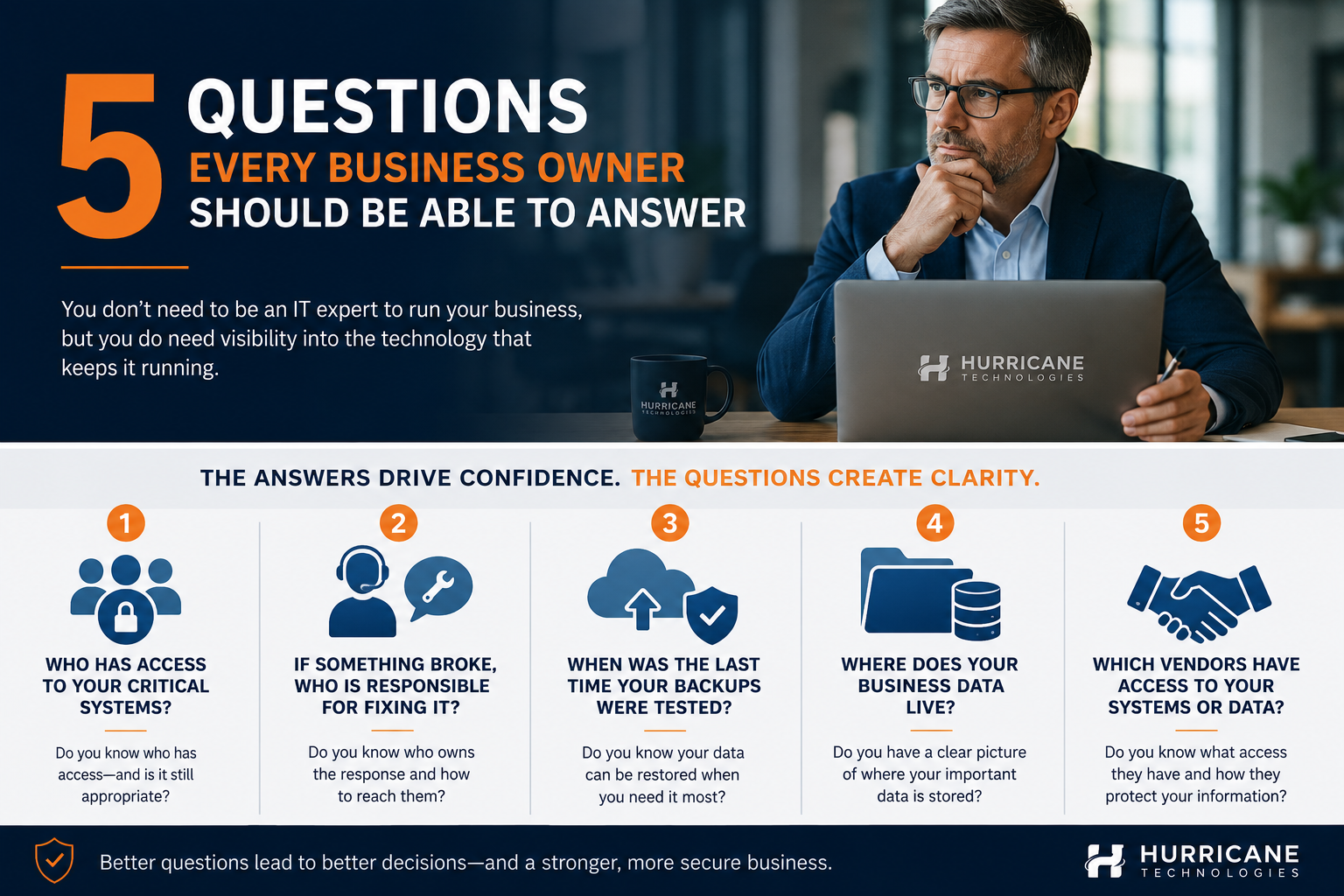
Here are five questions every business owner should be able to answer.
1. Who Has Access to Your Critical Business Systems?
Think about the applications your organization depends on most.
Your email platform. Accounting software. CRM. File storage. Industry-specific applications.
Do you know who currently has access to those systems?
As organizations grow, access tends to accumulate. New employees are added. Contractors receive temporary permissions. Employees change roles and retain access they no longer need.
Over time, it becomes difficult to determine who has access to what—and whether that access is still appropriate.
This isn’t about trust. It’s about reducing risk and maintaining control of your business environment.
Ask yourself: If you reviewed user access today, would anything surprise you?
2. If a Critical System Went Down, Who Owns the Response?
Every business relies on technology. But when something stops working, responsibility isn’t always clear.
Maybe one vendor manages your software. Another manages your internet connection. Someone else handles cybersecurity. Internal staff are involved as well.
Without clear ownership, resolving issues can take longer than necessary. Valuable time gets spent determining who to call instead of focusing on recovery.
When downtime occurs, accountability should never be a question.
Ask yourself: If a critical system failed right now, do you know exactly who would take the lead in resolving the issue?
3. When Were Your Backups Last Tested?
Most businesses have backups.
Far fewer have verified that those backups can be restored successfully.
A backup strategy is only effective if it works when you need it. New applications, changing workflows, and growing data volumes can all impact your ability to recover from an outage, cyberattack, or accidental deletion.
Testing recovery processes helps identify problems before they become business disruptions.
Because when a recovery event occurs, that’s not the time to discover something was missed.
Ask yourself: How confident are you that your business could recover critical data if it had to?
4. Where Does Your Business Data Live?
For many organizations, business data exists in more places than they realize.
It’s stored in cloud platforms, email systems, shared drives, collaboration tools, mobile devices, and third-party applications. New tools are added regularly, and information often spreads across departments and teams.
The more distributed your data becomes, the more important visibility becomes.
Knowing where data resides helps you protect it, back it up properly, meet compliance requirements, and respond effectively when issues arise.
Ask yourself: Could you confidently identify where your most important business information is stored today?
5. Which Vendors Have Access to Your Systems or Data?
Modern businesses depend on a growing ecosystem of vendors and service providers.
Accounting platforms, payroll systems, marketing tools, cloud applications, consultants, managed service providers, and software integrations all play important roles in daily operations.
Many of these relationships require some level of access to company systems or data.
The goal isn’t to eliminate vendor access. It’s to understand it.
Knowing which vendors have access, what information they can view, and how they protect that information is an important part of managing business risk.
Ask yourself: Do you have a clear inventory of third parties that can access your systems or data?
Visibility Creates Better Decisions
None of these questions are highly technical.
They’re business questions.
The answers provide insight into how well your technology environment supports your organization, protects your information, and reduces operational risk.
As businesses grow, systems change, vendors are added, and access expands. Without regular review, it’s easy for visibility to fade over time.
The good news is that most gaps can be identified and addressed before they become costly problems.
At Hurricane Technologies, we help business leaders gain clarity around their technology environment, identify areas of risk, and build strategies that support long-term growth. Sometimes the most valuable outcome isn’t finding a problem—it’s gaining confidence that the right safeguards are already in place.
Book Time with Us
If you’re unsure how you’d answer one or more of these questions, it may be time for a technology review. A fresh perspective can often uncover opportunities to improve security, resilience, and operational efficiency.